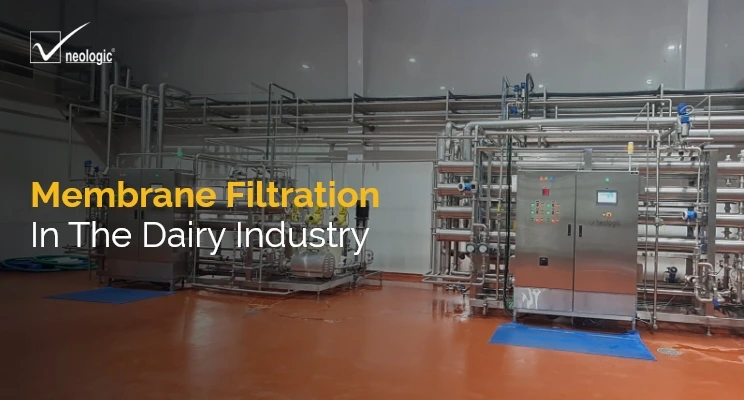
Membrane Filtration In The Dairy Industry
The dairy industry relies on advanced technologies to enhance product quality, optimize processes, and ensure sustainability. Membrane filtration is a key technology that plays a crucial role in separating and concentrating milk and whey components. This process improves efficiency, reduces waste, and enables the production of specialized dairy products such as lactose-free milk, high-protein dairy ingredients, and purified whey protein concentrates. With this blog, you will learn about different types of Membranes and their various applications.
Membrane Technology Overview
Membrane filtration is a separation process which separates a liquid into two streams by means of a semi permeable membrane. The two streams are referred to as retentate and permeate. By using membranes with different pore sizes. It is possible to separate specific components of milk and whey. Depending on the application in questions, the specified components are either concentrated or removed/reduced.
Types of Membrane Filtration
Membrane filtration can basically be divided into four main technologies:
Microfiltration (MF)
Microfiltration is a low pressure-driven membrane filtration process based on a membrane with an open structure. It allows dissolved components to pass, while most non-dissolved components are rejected by the membrane. In the dairy industry, microfiltration is widely used for bacteria and spore reduction and fat removal in milk and whey. As well as for protein and casein standardization.
Ultrafiltration (UF)
Ultrafiltration is medium pressure-driven membrane filtration process. Ultrafiltration is based on a membrane with a medium open structure allowing most dissolved components and some non-dissolved components to pass, while larger components are rejected by the membrane. In dairy industry, Ultrafiltration is widely used in concentration of whey protein concentration and milk protein concentration and or Standardization.
Nanofiltration (NF)
Nanofiltration is medium to high pressure-driven membrane filtration process. Generally speaking, nanofiltration is another type of reverse osmosis where the membrane has slightly more open structure allowing predominantly monovalent ions to pass through the membrane. In the dairy industry nanofiltration is mainly used for special applications such as partial demineralization of whey, lactose free milk or volume reduction of whey.
Reverse Osmosis (RO)
Reverse osmosis is high pressure-driven membrane filtration process which is based on very dense membrane. In principle, only water passes through the membrane layer. In the dairy industry, reverse osmosis is normally used for concentration or volume reduction of milk and whey, milk solids recovery and water reclamation.
Applications of Different Membranes in the Dairy Processing Industry
1. Microfiltration (MF)
Bacteria Reduce
- ESL (extended shelf life) milk: Microfiltration is widely used in the production of high-quality market milk and ESL milk. Traditional heat treatment inactivates microorganisms, but also denatures whey proteins and some vitamins and impacts taste. With microfiltration, there is physical removal of bacteria, spores, dead cells and other impurities, protecting the composition of the milk and its natural taste.
- Cheese milk: Improvement of cheese milk can be achieved using microfiltration. The natural content of anaerobic spores in milk - such as clostridia - which can survive normal pasteurization and cause undesired gas formation in the cheese, can be reduced by means of microfiltration. Furthermore, microfiltration can avoid or significantly reduce the addition of normal inhibitors (e.g., nitrate), thereby achieving preservative-free cheese and whey.
- Milk and whey ingredients: Microfiltration can considerably improve the quality of milk and whey powder and high value dairy ingredients through a gentle reduction of bacteria and spores. As a consequence, heat treatment can be kept at an absolute minimum which - among other things - contributes to a preservation of the functional properties of the whey proteins in the powder.
Milk Protein Fractionation
- Casein standardization of cheese milk: When it comes to obtaining process control and quality, a uniform and stable production process is of the highest importance. By using microfiltration, it is possible to fractionate casein and whey proteins. Thereby it is possible to standardize the concentration of casein in the cheese milk to obtain the correct ratio between casein and fat.
- Micellar casein (MCI) and native whey production: Microfiltration can fractionate milk proteins into casein and whey proteins. The fractionated casein can be used in the production of high-quality casein or caseinate or in the production of micellar casein for casein-rich milk products. The native whey fraction (permeate) contains whey proteins in their natural form which are unaffected by heat treatment, enzymes (rennet) or bacteria (starter cultures). This product is especially suited for the production of high-quality liquid stabilizer, whey protein concentrate (WPC) and whey protein isolate (WPI). the highest sensitivity at each point.
- Fat removal: In the production of protein isolate - e.g., milk protein isolate (MPI) or whey protein isolate (WPI) - where a protein level of more than 90% in total solids is required, the fat content constitutes a limiting factor. The residual fat is concentrated to a very high level, and in order to achieve the final protein concentration, removal of the milk fat is required. Microfiltration is the obvious solution for performing this fat removal.
2. Ultrafiltration (UF)
Protein concentration
- Cheese milk: Ultrafiltration followed by a standard cheese production process can be used for pre-concentration of cheese milk. In this way, the protein level of the cheese milk is raised and kept constant, which contributes to optimization and increased throughput of the cheese making equipment. The by-product of the ultrafiltration process (permeate) is perfectly suited for lowering the protein content of other products, such as skim milk powder.
- Milk protein concentrate: Ultrafiltration is commonly used in the production of milk protein concentrate (MPC) where it can lead to an increase in the protein content of the total solids. The co-product (permeate) is perfectly suited for lowering the protein content of other products such as skim milk.
- Whey protein concentrate: Whey protein concentrate (WPC) is obtained using ultrafiltration on different whey types (sweet, acid or casein) or different types of permeates from microfiltration of milk. Depending on the required protein concentration level, different ultrafiltration techniques can be applied (e.g., dilution with water also known as diafiltration). The final composition of the WPC depends on several factors, such as the original composition, the level of concentration, the membrane itself and the processing parameters. The by-product (permeate) - mainly containing lactose - is suitable for further valuable processes.
Protein Standardization
- Milk: Ultrafiltration can be used to standardize and increase the protein content of milk without the use of additives such as milk powder. Protein-enriched milk has additional health benefits and improved taste, and is also very suitable for the production of fermented milk products (yogurt, crème fraîche, kefir, etc.). To optimize the protein utilization in the dairy, the ultrafiltration permeate can be used for lowering the protein content of the milk.
- Cheese milk: As the protein content of milk varies significantly depending on the season and the breed of cow in question, it can be difficult to maintain a constant protein level. Protein standardization using ultrafiltration can eliminate these protein variations, providing a more uniform cheese product.
- High-grade lactose by decalcification (calcium removal): In the production of lactose, ultrafiltration can be used as a separation process for the decalcification of pre- concentrated permeates (by RO or preferably NF), resulting in a very pure lactose solution.
As calcium-phosphate is highly insoluble, it can be easily removed by means of UF following a thermal precipitation process. Applying this technology will, in general, result in high-quality lactose, where the reduction of calcium phosphate will lead to a higher lactose yield and lower mineral content in the final lactose product as well as improved evaporator running times. Depending on the UF separation unit ‘s concentration degree, calcium can be refined into a natural calcium-phosphate product.
Yield increase
- White cheese: Ultrafiltration is widely used in the production of white cheese where whole milk is concentrated to 34-40% total solids by means of ultrafiltration. The retentate (concentrate) from the ultrafiltration process is pasteurized and mixed with starter culture, rennet and salt and subsequently filled directly into the packaging, where the entire cheese production process then takes place. The process increases the yield by more than 20% compared to traditional production methods.
- Fermented products: Fermented products is a term used for fresh cheese products like quark, cottage cheese, fromage frais, cream cheese and many more. By including ultrafiltration in the production of fermented cheese, it is possible to adjust the product in order to achieve the exact combination of consistency, texture and flavor. A standardization of the protein level prior to fermentation for these types of products will result in several benefits such as yield increase and a reduction in the amount of acid whey.
3. Nanofiltration (NF)
Concentration
- Whey and permeate: Nanofiltration of whey and permeate will reduce the mineral content – especially sodium and potassium chlorides (monovalent ions) – in these products, and since both whey and permeates in most cases need to pass through a concentration step prior to further processing, nanofiltration becomes a very attractive technology, as it combines volume reduction with partial demineralization in the same process step.
- Volume reduction: In order to achieve savings on transportation costs, it is possible to apply nanofiltration for volume reduction (concentration) of whey and permeates. With nanofiltration technology higher flux rates can be achieved, making nanofiltration a financially attractive alternative compared to other technologies, e.g., reverse osmosis.
- Lactose: Lactose is mainly produced from whey and permeates, and nanofiltration plays an important role in a modern lactose production facility. By applying nanofiltration, lactose can be concentrated before further processing, i.e., evaporation and crystallization. Further, nanofiltration will reduce the mineral content which, in turn, will provide a more efficient crystallization process and will consequently result in a lactose product with a higher degree of purity.
- Final concentration of WPC or WPI: Nanofiltration can be used for the final concentration after ultrafiltration processing of WPC. In this way, the energy costs for spray drying can be significantly reduced and the capacity increased.
Partial demineralization
- Demineralized whey: When producing demineralized or non-hygroscopic whey powder where low lactose and mineral contents are required, nanofiltration can be applied as an economically attractive supplement to electrodialysis and ion-exchange technologies. Depending on the type of whey, the demineralization degree can reach more than 30%, making the electrodialysis and ion exchange processes more efficient.
- Demineralized whey powders: Demineralized whey powders (DWP D35, D50, D70, D90) intended for use in the production of baby food, can - depending on the degree of demineralization - be manufactured by means of nanofiltration, and combinations of ultrafiltration and nanofiltration as well as nanofiltration combined with electrodialysis (ED) before evaporation and spray drying.
- Lactose free milk: Nanofiltration can be used in conjunction with microfiltration for the production of high-quality lactose-free milk products. The combination of microfiltration and nanofiltration technologies produces a milk with most of the original composition and a sensory experience which is almost similar to that of fresh milk.
- Purification of CIP (Cleaning In-Place) solutions: In processing plants where the acid and caustic consumption is high, nanofiltration can be applied in order to achieve purification of the CIP solutions used (e.g., NaOH and HNO3). Removal of impurities and reduction of the COD level enable a very long recycling period, where the loss of acid and caustic is reduced to a minimum. In order to maintain a constant concentration level, priming will still be required.
4. Reverse Osmosis (RO)
Pre-concentration
- Supplement to evaporation: Reverse osmosis can be applied as a supplement to evaporation. If a new evaporation line is required or an existing line is to be extended, substantial savings can be obtained by joining the two technologies. Reverse osmosis is a very efficient way of removing water from the milk or whey prior to the evaporation stage. By installing a reverse osmosis plant upstream to an existing evaporator, the capacity of the evaporator can be increased considerably.
- Total solids increase: Reverse osmosis can be used to concentrate skim milk or whole milk in order to increase the total solids content. This is also relevant for fermented products. As reverse osmosis practically removes only water, the technology can be applied as an energy efficient alternative to evaporation or the addition of milk powder, which are the most common ways of increasing the total solids content of milk.
- Volume reduction: Reverse osmosis can be applied to reduce the volume of milk or whey, e.g., for saving transportation costs. Volume reduction based on reverse osmosis is an alternative to nanofiltration.
- Product recovery: In order for a modern dairy production facility to be able to meet the economic and environmental demands put forward by the surrounding society, waste recovery has become increasingly important. From the first cleaning flush, “white water” is collected in a dedicated collection tank. The sweet “white water” is concentrated to the required total solids content by applying reverse osmosis, and the recovered solids can subsequently be returned to the production process, e.g., to increase the total solids in yogurt milk. The by-product of this concentration process (water) can also be utilized as described in the following section.
- Water recovery and Polishing: Permeates originating from reverse osmosis or nanofiltration processes as well as condensates from evaporators are practically water. With an additional reverse osmosis treatment normally referred to as “polishing,” this water can be purified and re-used for cleaning purposes. With further heat treatment or UV light treatment, it is even possible to use the water as process water.
- Effluent control: Some production facilities, such as large whey processing sites, have an excess amount of water which must be discharged. As water disposal is normally connected with emission taxes subjecting the water to a reverse osmosis process can lower the COD level and reduce these taxes.
In Conclusion, membrane filtration system has revolutionized the dairy industry by enabling precise separation and concentration of milk and whey components. Technologies such as microfiltration, ultrafiltration, nanofiltration, and reverse osmosis offer numerous benefits, including improved product quality, enhanced efficiency, and reduced waste. By implementing these membrane filtration techniques, dairy manufacturers can optimize production processes, develop high-value dairy ingredients, and promote sustainability in dairy processing.